START TODAY! | FREE TRIAL


Lindsay Brin, BS Exercise Science
Our bodies change over time. The secret is redefining your workouts and moving in ways that honor it. With strength, walking, and purpose, you can feel vibrant again—energized, confident, and at home in your body.
When it comes to resistance training, many women fear that lifting heavier weights will lead to a “bulky” physique. I’ve felt that fear too—especially on my 5’1” frame. And we’ve all seen the debate: lift heavy for fewer reps or use lighter weights for higher reps. Both camps claim to be the only path to better body composition. So…what actually works?
Lifting light and lifting heavy both build muscle, but they’re not equal when it comes to bone strength in perimenopause and post menopause…more on that in a minute.
> Lifting light typically means a weight you can lift for 12–20+ reps, often 30–70% of your 1RM.
> Lifting heavy typically means 6–12 reps at about 70–85% of your 1RM.
Your 1 Rep Max (1RM) is the heaviest weight you could lift one time with good form. Most people never test this, and you don’t need to. Pick a weight you can lift for about 10 reps. If the last 2 reps feel challenging—but still doable with good form—you’re right around the intensity you need.
But does lifting light build muscle as effectively as lifting heavy?
Surprisingly, yes. Research shows that lifting a very light load for high reps can stimulate similar muscle growth to heavier loads when the set is taken to high effort. Multiple studies support this [2–6].
Effort Is What Matters. How you reach that effort matters too:
Research shows that training with 0–3 reps in reserve (RIR) builds strength and muscle just as effectively as going all the way to failure. The difference is that failure creates more fatigue and stress on the nervous system without offering any meaningful extra benefit.
That’s why in our Weekly Schedule we use RIR instead of failure. You still work hard enough to see results, but you avoid the unnecessary fatigue, cortisol spike and burnout that failure training can create. RIR makes your training more effective and more sustainable.
As hormones shift in your 30s and 40s, bone loss accelerates. It sounds discouraging, but it’s actually an opportunity. Bones respond to load. Challenge them and they adapt.
Strength training is the strongest protector of bone after 40.
The LIFTMOR Trial (80–85% 1RM)
One of the most widely cited bone-density studies, LIFTMOR used very heavy lifting, about 4–6 reps under full supervision, twice weekly. Participants already had osteopenia or osteoporosis and still gained bone safely at the spine and hip.
2023 and 2025 Research (65–80% 1RM)
Newer studies show that women also build strong bones using moderate to high loads, or 6–12 challenging reps, done 3× per week. These protocols produced consistent gains in spine and hip bone density for postmenopausal women.
You do not need to lift at your max. You need strength workouts where the last few reps feel challenging but not impossible—week after week.
Research also shows that just a few minutes of small jumps or purposeful force through the legs can strengthen bone at the hip and spine.
You can simply layer in a few 20-second SIT sprints during one weekly walk or 1–2 minutes of small, controlled jumps
Small additions work, especially paired with strength training.
To address the fear of getting bulky while still reaping the benefits of resistance training, women can combine different lifting strategies:
Our goal is simple: build and preserve muscle while supporting healthy body composition.
Inside the Studio, we strength train together and you add your daily steps. This combination improves metabolism, bone density, hormone balance, and energy without burnout.
Choose the plan that feels right: 2×, 3×, or 4× strength days per week. Try it free!
[1] ACSM’s Guidelines for Exercise Testing and Prescription, eleventh edition.
[2] American College of Sports Medicine. Progression models in resistance training for health adults. Med Sci Sports Exerc. 2009;41 (3):687-708.
[3] Schoenfeld BJ, Grgic J, Ogborn D, Krieger JW. Strength and Hypertrophy Adaptations Between Low- vs. High-Load Resistance Training: A Systematic Review and Meta-analysis. J Strength Cond Res. 2017 Dec;31(12):3508-3523. doi: 10.1519/JSC.0000000000002200. PMID: 28834797.
[4] Schoenfeld BJ, Grgic J, Van Every DW, Plotkin DL. Loading Recommendations for Muscle Strength, Hypertrophy, and Local Endurance: A Re-Examination of the Repetition Continuum. Sports (Basel). 2021 Feb 22;9(2):32. doi: 10.3390/sports9020032. PMID: 33671664; PMCID: PMC7927075.
[5] Wernbom M, Augustsson J, Thomee R. The influence of frequency, intensity, volume, and mode of strength training on whole muscle cross-sectional area in humans. Sports Med. 2007;37(3):225-64.
Burd NA, Mitchell CJ, Churchward-Venne TA, Phillips SM. Bigger weights may not beget bigger muscles: evidence from acute muscle protein synthetic responses after resistance exercise. Appl Physiol Nutr Metab. 2012 Jun;37(3):551-4. doi: 10.1139/h2012-022. Epub 2012 Apr 26. PMID: 22533517.
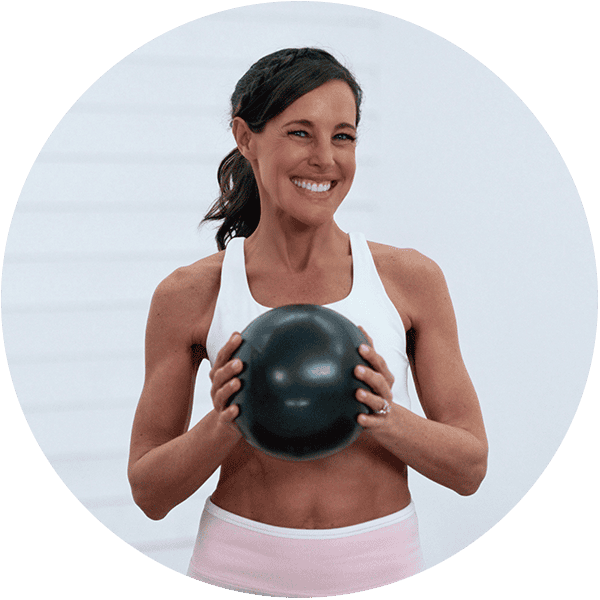
Lindsay Brin holds a degree in Exercise Science and has over 20 years of experience helping women, especially women over 40, build strength and redefine what fitness means for life. She has certified Pilates instructors and CPTs across the U.S. and developed a fitness course accredited by National Academy of Sports Medicine (NASM) and American Council on Exercise (ACE).
But her most transformative learning came after 40, when she began experiencing perimenopause. Lindsay immersed herself in the science of aging, hormones, walking, HIIT, and strength training—ultimately developing a method that works with your body, not against it.
This is now the foundation of Moms Into Fitness, which has helped over 85,000 women rebuild strength, renew energy, and create lasting results.