START TODAY! | FREE TRIAL

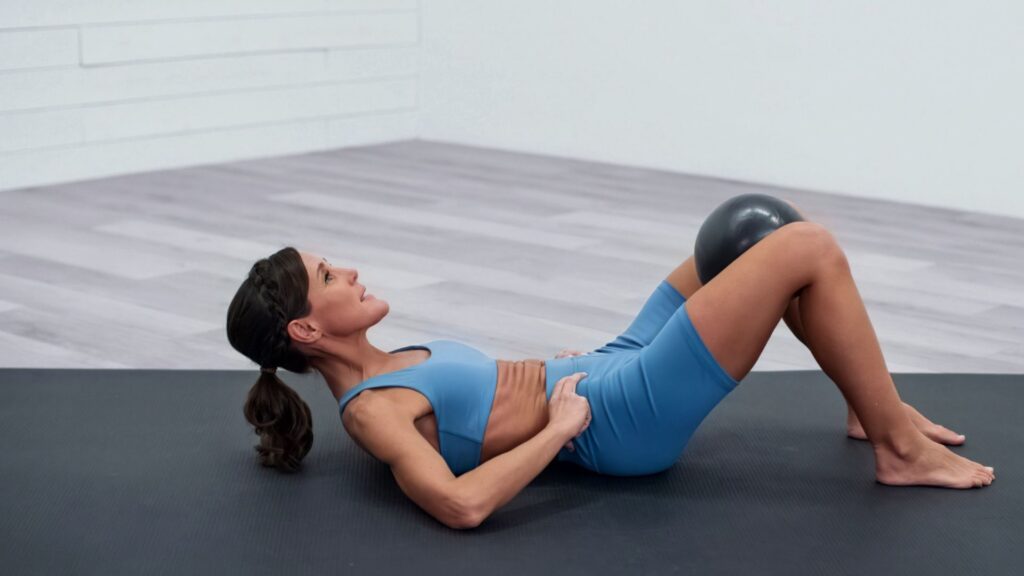
There are two times in a woman’s life when her core changes the most: after pregnancy… and during midlife.
The reasons are different. But the solution is surprisingly the same.
For years, transverse abdominis exercises were mostly talked about in the postpartum space—helping women rebuild after pregnancy and support diastasis recti. But what many women don’t realize is this: the same deep core system becomes just as important again after 40.
Hormonal shifts, changes in muscle mass, and stress physiology can all influence how your midsection looks and feels, including the stubborn belly fat that appears in midlife. And while fat distribution may change, the structure of your core still matters most.
Transverse abdominis exercises strengthen your deep core—the muscle that acts like a corset around your midsection.
The most effective way to train it is:
Below are the 7 transverse abdominis exercises (in the exact order we recommend) to help you rebuild connection and strength. We use these same movements inside all of our workouts.
If your core feels disconnected or you want a done-for-you plan, download our free Core Guide to start rebuilding your deep core connection.
Before anything else, you need to feel this muscle working—and you can do this right from your chair. Sit tall with your feet flat on the floor and your spine neutral (not tucked or overly arched). Place your fingertips just inside your hip bones.
Take a deep inhale. Then as you exhale, make a slow “ssssss” sound and feel a gentle tightening under your fingertips. This is your transverse abdominis activating.
You can also practice this lying on your back—the same cues apply. This is the same movement you’ll use in Exercise #1 below.
Start with Level 1 and only progress when you can maintain control. Most women skip this step…and that’s why they don’t see results.
Start in a supine position with your fingertips placed just inside your hip bones.
Take a deep inhale. Then as you exhale, make a slow “ssssss” sound and feel a gentle tightening under your fingertips.
Maintain a neutral pelvis and avoid gripping your glutes. This should feel like a subtle contraction, not sucking in your stomach.
These transverse abdominis exercises work on a deeper level than traditional ab work:
And yes! This can improve the appearance of a “mommy belly,” a lower belly pouch, or the midlife midsection that often feels harder to change after 40.
But the real goal goes beyond aesthetics. It’s about restoring core function and structure so your midsection feels supported instead of pushed outward.
Traditional ab exercises focus on the rectus abdominis, the outer “six-pack” layer. But that’s not what creates structure.
If the transverse abs are not activating properly, stronger muscles take over. Pressure shifts outward, and the stomach can actually appear wider, even with consistent exercise. This also exacerbates ab separations and diastasis recti.
As Diane Lee explains: “You cannot strengthen a muscle your brain doesn’t know it has.”
That’s why this approach is different.
Changes in your midsection are not always about body fat.
The abdomen is shaped by muscle support, posture, and deep core coordination. When these systems are working well, the torso feels supported and strong. When they’re not, the stomach can begin to push outward instead of being supported inward.
As your body changes, many women notice a rounder or softer stomach, core exercises feeling less effective, or more tension in the lower back and hips.
When the deep core loses efficiency, the torso can lose its structure and the stomach may push outward instead of being supported inward.
That’s why this is not just about doing more ab workouts. It’s about training the right layer of the core.
Deep core work alone isn’t enough.
The most effective approach combines:
Instead of overtraining abs, focus on:
2–3 strength workouts + 1 focused deep core session + Daily walking
This is where real change happens. Try Rebuild Your Core FREE for 7 days. We incorporate deep core into our full body strength workouts.
While diastasis recti is most common after pregnancy, similar patterns of core weakness can show up in midlife. That’s why the same foundational approach applies. Download our Core Guide to start rebuilding your core.
Yes. After 40, hormonal shifts and changes in muscle efficiency often cause the deep core (transverse abdominis) to stop firing properly. When that happens, the body compensate. Hip flexors take over, the lower back steps in, and the outer abs dominate. It’s about retraining the brain-to-muscle connection so this deep core muscle activates automatically. This is called neuromuscular re-education.
Most women lose connection to the TA over time due to stress, sitting, past pregnancies, or hormonal changes. It’s completely normal if you don’t feel it right away. Keep practicing the “ssssss” breath with your fingertips just inside your hip bones. Many women need 1–2 weeks of daily practice before it clicks. This is the simple step most women have been missing.
Traditional ab exercises focus on the outer “six-pack” layer (rectus abdominis). Transverse abdominis exercises target the deepest corset muscle first. When the TA activates properly, it creates real structure and helps prevent the stomach from pushing outward.
Yes. These 7 exercises are designed to approximate the recti bellies and strengthen the integrity of the linea alba. Whether your diastasis is from pregnancy or similar core weakness, the foundational approach of activating the transverse abdominis first is the same. Many women with mild to moderate separations see improvement quickly with consistent practice.
Very often yes. The transverse abdominis stabilizes the spine and pelvis before movement. Many women notice less lower back tension and better posture once they relearn this deep core connection.
Start with 5 minutes most days focusing on activation and Level 1–2 moves. Once you have good control, layer them into your regular strength workouts 2–3 times per week. Consistency with the activation cue matters more than long sessions. If you want this done for you, use our Core Programs. Your first 7 days are free!
Most women feel better core connection within 1–2 weeks. Improvements in posture, reduced pushing outward and a more supported midsection usually appear in 4–6 weeks when combined with strength training and daily walking.

Lindsay Brin holds a degree in Exercise Science and has over 20 years of experience helping women, especially women over 40, build strength and redefine what fitness means for life. She has certified Pilates instructors and CPTs across the U.S. and developed a fitness course accredited by National Academy of Sports Medicine (NASM) and American Council on Exercise (ACE).
But her most transformative learning came after 40, when she began experiencing perimenopause. Lindsay immersed herself in the science of aging, hormones, walking, HIIT, and strength training—ultimately developing a method that works with your body, not against it.
This is now the foundation of Moms Into Fitness, which has helped over 85,000 women rebuild strength, renew energy, and create lasting results.